Client Challenge
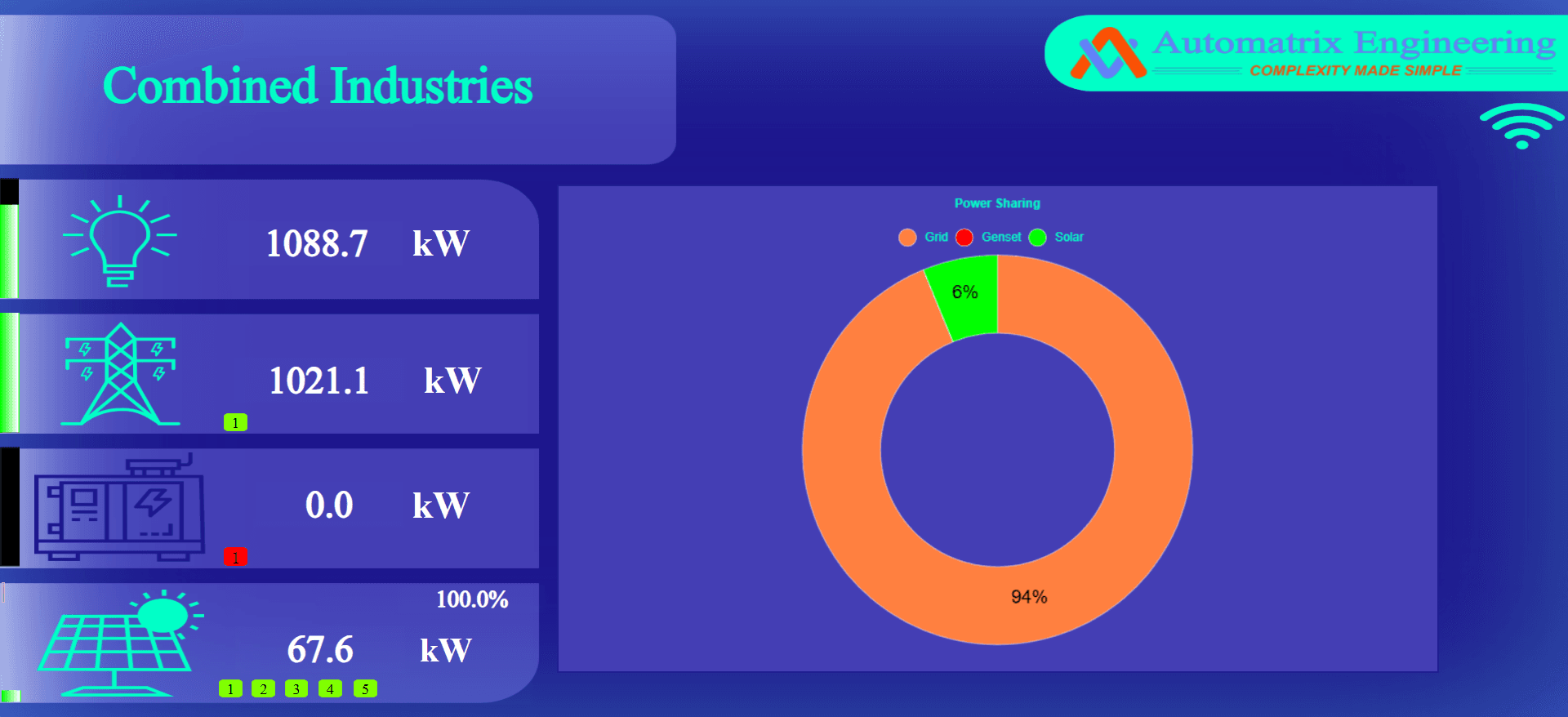
Combined Industries needed automatic power source selection between a 500kW solar system, a 1000 KVA diesel generator, and WAPDA grid supply, without manual intervention or unstable voltage during transitions.
PLC-based Solar-DG synchronization system for Combined Industries, integrating a 500kW solar PV array with 7 Sungrow inverters, a 1000 KVA diesel generator, and WAPDA grid supply with zero-export mode.
Industry
Industrial
Location
Pakistan
Solution
PV-DG Synchronization
Primary Outcome
Reduced manual intervention
Answer-first summary for technical buyers, consultants, and AI-assisted research workflows.
Combined Industries needed automatic power source selection between a 500kW solar system, a 1000 KVA diesel generator, and WAPDA grid supply, without manual intervention or unstable voltage during transitions.
PLC-based Solar-DG synchronization controller integrating solar PV, a large diesel generator, and WAPDA grid supply for an industrial manufacturing facility.
PLC-based Solar-DG synchronization controller integrating solar PV, a large diesel generator, and WAPDA grid supply for an industrial manufacturing facility.
Deployed a PLC-based Solar-DG Synchronization Controller that prioritizes solar power and seamlessly switches to grid or generator as needed. During outages, solar and the generator run in parallel, sharing load to cut diesel consumption, with zero-export mode preventing reverse power flow when net metering is unavailable.
Installed a touchscreen HMI for local control plus remote access for real-time monitoring, configuration, and fault alerts, with the ability to remotely start or stop equipment as needed.
Protection and compliance controls included reverse power protection, configurable alarms, and controlled switching logic based on site conditions.
Up to 60% fuel savings through optimized solar-DG integration, uninterrupted power supply via auto-switching, reduced manual effort, and 24/7 remote monitoring.
Electrical SLD snapshots, HMI/SCADA views, panel documentation, and commissioning records.
3MW Solar PV-DG Synchronization for Al-Rehman Garden P-II Power Plant
Automatrix Engineering deployed a 3MW solar PV system with a PLC-based Solar-DG synchronization controller at Al-Rehman Garden P-II Power Plant, integrating three Huawei inverters with multiple HFO diesel generators and zero-export protection.
PV-DG Synchronization Controller Commissioning at Shaikhpura
Commissioning of a PV-DG Synchronization Controller integrating 13 solar inverters, 3 diesel generators and the utility grid into one centralized hybrid power system.
Zero Export Controller Deployment at Butterfly Industry
An intelligent zero-export controller maintaining full compliance by preventing reverse power flow to the grid, with sub-second response and multi-inverter compatibility.
Combined Industries needed automatic power source selection between a 500kW solar system, a 1000 KVA diesel generator, and WAPDA grid supply, without manual intervention or unstable voltage during transitions.
Installed a touchscreen HMI for local control plus remote access for real-time monitoring, configuration, and fault alerts, with the ability to remotely start or stop equipment as needed.
Reduced manual intervention, Better export compliance, Improved power reliability
Share your load profile, control objectives, and site constraints. We will propose architecture options, implementation scope, FAT/SAT plan, and support model.