Client Challenge
Butterfly Industry's solar installation risked exporting excess power back to the grid without net metering in place, creating regulatory compliance risk and potential penalties.
An intelligent zero-export controller maintaining full compliance by preventing reverse power flow to the grid, with sub-second response and multi-inverter compatibility.
Industry
Industrial
Location
Pakistan
Solution
PV-DG Synchronization
Primary Outcome
Reliability Improvement
Butterfly Industry's solar installation risked exporting excess power back to the grid without net metering in place, creating regulatory compliance risk and potential penalties.
Project scope details are available from the engineering team.
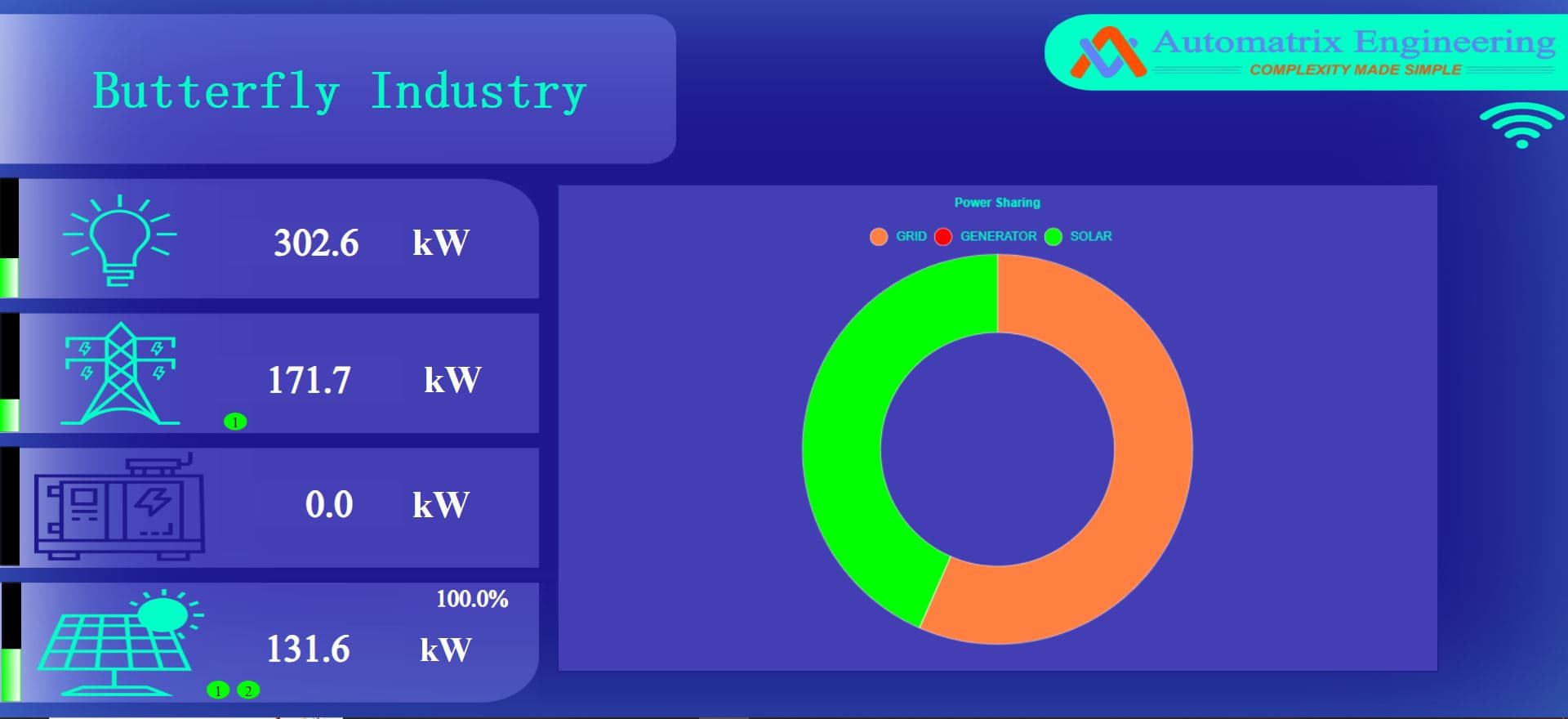
Automatrix deployed its Zero Export Controller to continuously monitor grid flow and dynamically limit inverter output, ensuring no reverse power is exported to the utility.
The controller delivers sub-1-second zero-export response time, dynamic power control based on real-time grid load, live monitoring of grid and solar voltage/current/power, adjustable export threshold from the HMI, compatibility with multiple inverter brands, and full data logging with SCADA/web dashboard access.
Butterfly Industry now operates in full compliance with zero-export requirements while maintaining unity power factor and stable grid frequency, with complete historical data available for reporting.
500kW Solar PV-DG Synchronization for Combined Industries
PLC-based Solar-DG synchronization system for Combined Industries, integrating a 500kW solar PV array with 7 Sungrow inverters, a 1000 KVA diesel generator, and WAPDA grid supply with zero-export mode.
3MW Solar PV-DG Synchronization for Al-Rehman Garden P-II Power Plant
Automatrix Engineering deployed a 3MW solar PV system with a PLC-based Solar-DG synchronization controller at Al-Rehman Garden P-II Power Plant, integrating three Huawei inverters with multiple HFO diesel generators and zero-export protection.
PV-DG Synchronization Controller Commissioning at Shaikhpura
Commissioning of a PV-DG Synchronization Controller integrating 13 solar inverters, 3 diesel generators and the utility grid into one centralized hybrid power system.
Butterfly Industry's solar installation risked exporting excess power back to the grid without net metering in place, creating regulatory compliance risk and potential penalties.
The controller delivers sub-1-second zero-export response time, dynamic power control based on real-time grid load, live monitoring of grid and solar voltage/current/power, adjustable export threshold from the HMI, compatibility with multiple inverter brands, and full data logging with SCADA/web dashboard access.
Better export compliance, More stable source coordination
Share your load profile, control objectives, and site constraints. We will propose architecture options, implementation scope, FAT/SAT plan, and support model.