Client Challenge
The mill's three powerhouses in different regions lacked a unified view of load flow and breaker status, making it difficult for operators to manage and control load distribution efficiently across sources.
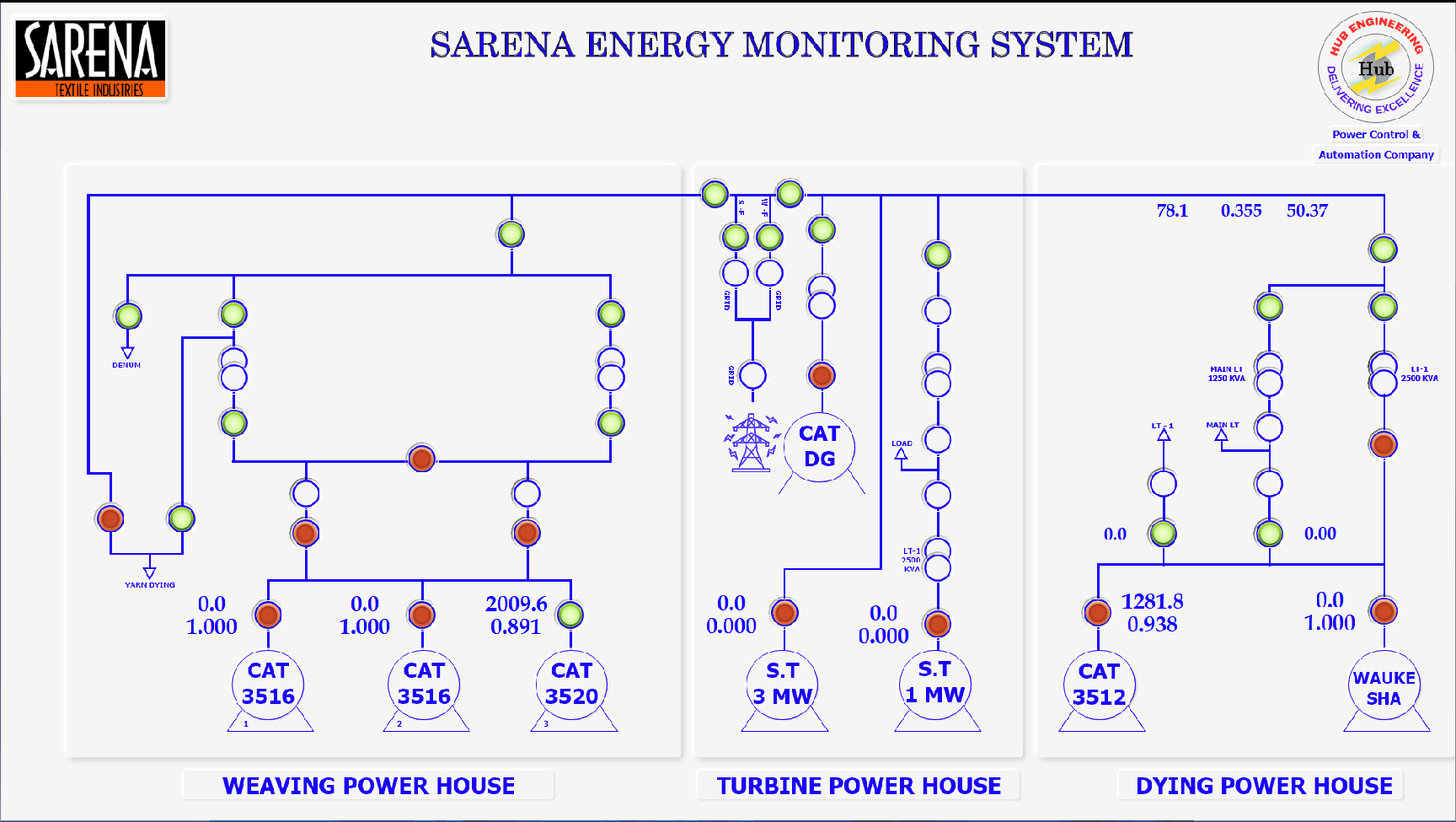
Real-time energy monitoring system for Sareena Textile Mill Shaikhupura, providing load flow visibility and breaker status monitoring across three separate powerhouses.
Industry
Textile
Location
Shaikhupura, Pakistan
Solution
Energy Monitoring & IIoT
Primary Outcome
Improved operational visibility
The mill's three powerhouses in different regions lacked a unified view of load flow and breaker status, making it difficult for operators to manage and control load distribution efficiently across sources.
Deployment of a real-time energy monitoring system across the three powerhouses (Dyeing, Weaving, and Turbine) of Sareena Textile Mill in Shaikhupura.
Implemented an Energy Monitoring System giving a complete overview of the load flow scheme, combined with real-time breaker status, across the Dyeing, Weaving, and Turbine power houses.
Configured real-time monitoring of each power generation source (Dyeing, Weaving, Turbine power houses) along with tracking of every outgoing load from sub-stations and continuous breaker status updates.
Operators now have real-time visibility into load flow and breaker status across all three powerhouses, enabling faster response and more efficient load distribution management.
PV Generator Controller System for AA Cotton Industries
A PV Generator Controller system synchronizing 5 solar inverters, a diesel generator and grid supply to optimize power distribution at a cotton processing facility.
500kW Solar-Diesel-Grid Synchronization for Zimal Textile
PLC-based solar-DG-grid sync with Zero Export, up to 60% fuel savings.
200kW Solar PV-DG Synchronization for Hometex Corporation
PLC-based Solar-DG synchronization system for Hometex Corporation, integrating a 200kW solar PV array with a 100 KVA diesel generator and WAPDA grid supply with zero-export mode.
The mill's three powerhouses in different regions lacked a unified view of load flow and breaker status, making it difficult for operators to manage and control load distribution efficiently across sources.
Configured real-time monitoring of each power generation source (Dyeing, Weaving, Turbine power houses) along with tracking of every outgoing load from sub-stations and continuous breaker status updates.
Improved operational visibility
Share your load profile, control objectives, and site constraints. We will propose architecture options, implementation scope, FAT/SAT plan, and support model.