Client Challenge
CCP Gulbai needed to combine solar generation, WAPDA grid, and a large 630 KVA diesel generator, but manual power source selection risked excess diesel consumption and reverse power issues without net metering.
A PLC-based Solar-DG Synchronization Controller integrating two SunGrow inverters with a 630 KVA diesel generator, delivering up to 60% fuel savings.
Industry
Manufacturing
Location
Pakistan
Solution
PV-DG Synchronization
Primary Outcome
Reduced manual intervention
Answer-first summary for technical buyers, consultants, and AI-assisted research workflows.
CCP Gulbai needed to combine solar generation, WAPDA grid, and a large 630 KVA diesel generator, but manual power source selection risked excess diesel consumption and reverse power issues without net metering.
Existing site architecture included mixed power sources and required structured integration for stable operations.
Control strategy design, panel-level integration, commissioning workflow, and operational handover.
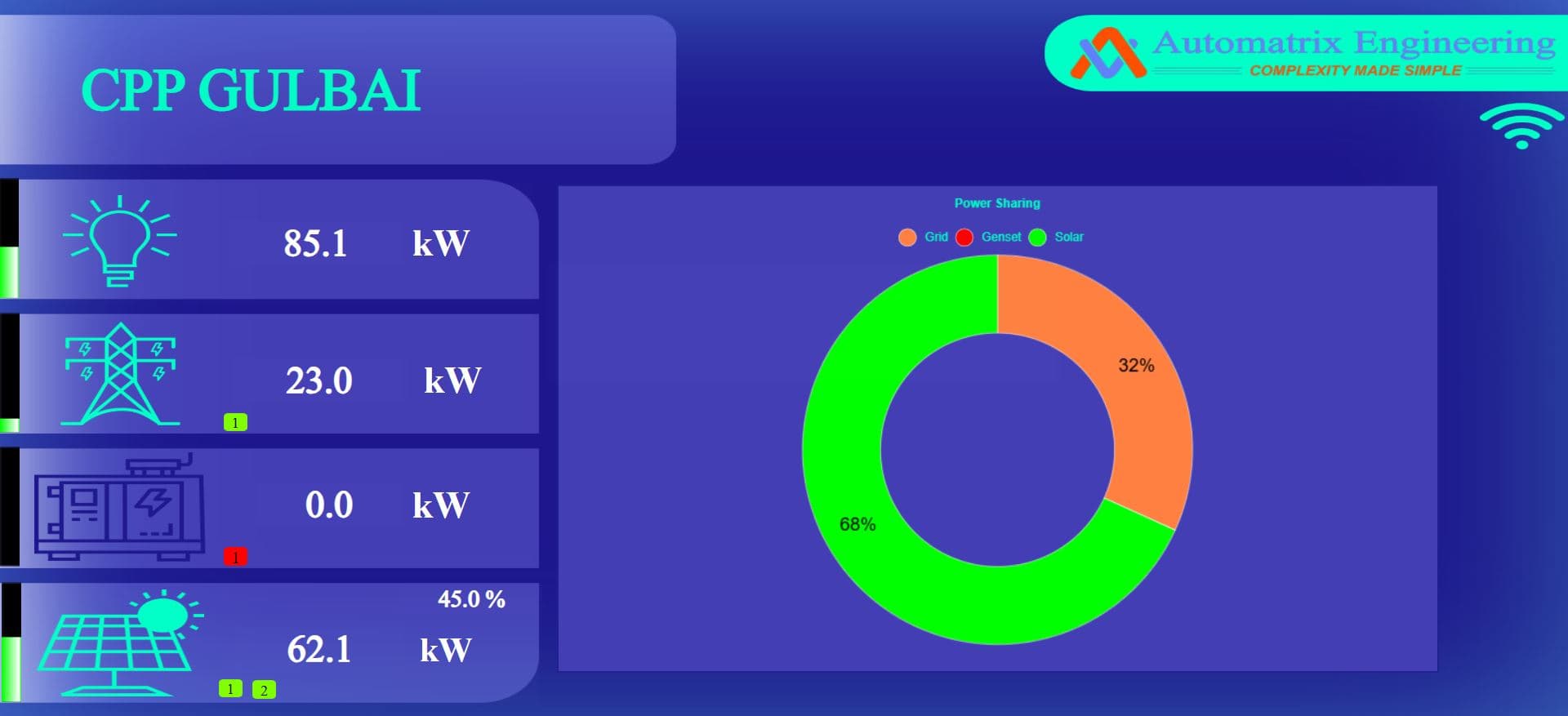
Automatrix deployed a PLC-based Solar-DG Synchronization Controller that automatically manages power source selection and load sharing between solar, grid and generator.
The controller prioritizes solar energy and seamlessly switches to grid or generator based on availability, enables parallel solar-generator operation during grid outages to share load and reduce diesel use, supports zero-export mode when net metering isn't available, and provides a touchscreen HMI plus remote monitoring with real-time fault alerts.
Protection and compliance controls included reverse power protection, configurable alarms, and controlled switching logic based on site conditions.
CCP Gulbai achieved up to 60% fuel savings, uninterrupted power through automatic switching, reduced manual effort, and 24/7 remote monitoring and management of its power system.
Electrical SLD snapshots, HMI/SCADA views, panel documentation, and commissioning records.
HFO Generator Monitoring & Control System for Ghani Value Glass
A real-time HFO (Heavy Fuel Oil) engine monitoring and SCADA control system delivering live trends, alarms, and generator start-stop automation.
Smart Energy Automation System for Techno Glass, Karachi
An integrated automation system synchronizing three solar inverters, a diesel generator and grid connection into one smart power management solution for a glass manufacturing plant.
CCP Gulbai needed to combine solar generation, WAPDA grid, and a large 630 KVA diesel generator, but manual power source selection risked excess diesel consumption and reverse power issues without net metering.
The controller prioritizes solar energy and seamlessly switches to grid or generator based on availability, enables parallel solar-generator operation during grid outages to share load and reduce diesel use, supports zero-export mode when net metering isn't available, and provides a touchscreen HMI plus remote monitoring with real-time fault alerts.
Reduced manual intervention, Improved power reliability
Share your load profile, control objectives, and site constraints. We will propose architecture options, implementation scope, FAT/SAT plan, and support model.